The short answer: start with the port, then confirm the pairing
Dell currently describes its commercial USB-C and Thunderbolt docks as intended for Dell Pro, Dell Pro Max, Dell Pro Precision, Latitude, Precision and some XPS laptops. That is a family-level starting point, not a complete compatibility list. Within any one family, generations can have different host ports, graphics limits and power needs. Dell says computers omitted from a dock's compatibility list may have limited functionality or errors.
A Dell laptop with a documented Thunderbolt port can be evaluated for a Thunderbolt dock. A model whose USB-C specification explicitly includes DisplayPort Alternate Mode can be evaluated for a native USB-C dock. A SuperSpeed USB-A laptop may use a compatible DisplayLink universal dock for office displays, but it will need software and a separate charger. A legacy Latitude or Precision with an E-Port connector belongs to the older mechanical-dock category. These routes are not interchangeable.
The reliable answer for one computer is therefore: identify it by Service Tag, open its manual, and cross-check the exact model against Dell's current compatibility guide for the dock. Do not shop from a generic phrase such as ‘Latitude compatible.’
A 90-second compatibility check
1. Name the exact laptop. Enter the Service Tag at Dell Support and open Manuals & Documents. Record the full model and generation—‘Latitude 5420’ is useful; ‘Dell laptop’ is not. For an employer-owned machine, also record the installed operating system and ask whether dock firmware or DisplayLink software is restricted.
2. Read the host-port specification. A USB-C connector's shape proves only that the plug fits. Look for Thunderbolt, or for USB-C with DisplayPort Alt Mode when considering a native USB-C video dock. If the manual documents only USB data, keep native video and charging marked unconfirmed. Dell's own guidance separates Thunderbolt, USB-C video, USB graphics, Rugged and legacy E-Port connections.
3. Check the exact dock matrix. Match the laptop row and dock column in Dell's current compatibility document. Then open the dock's user guide for the complete monitor arrangement and charging output. A supported pairing can still have fewer screens or less charging than the headline maximum because host graphics, DisplayPort bandwidth, Display Stream Compression, operating system and cable routing all matter.
Need to compare actual models while you read?
See relevant dock optionsThree Dell dock routes, with different compromises
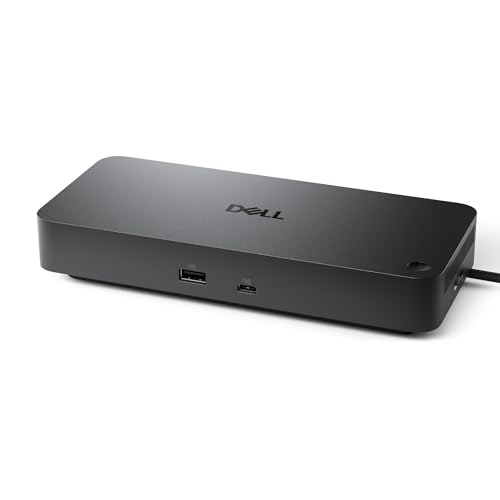
For USB-C business laptops: the Dell WD25 is the practical candidate in this catalog. Dell lists Windows 10, Windows 11, Ubuntu, Red Hat Enterprise Linux and ChromeOS on the checked product page; macOS is not in that table. The dock uses the host's native DisplayPort video path, so its four-display ceiling does not apply to every USB-C computer. Dell's published examples change substantially depending on whether the host supports Display Stream Compression.
For Thunderbolt 4 business laptops: the Dell SD25TB4 adds downstream Thunderbolt connections and remote-management features. Those management functions are valuable in a supported corporate deployment and mostly unnecessary at an unmanaged home desk. Dell states up to 130W charging for supported Dell systems and 96W for non-Dell systems with this configuration; the 180W wall adapter is not the amount sent to the laptop.
For USB-A or mixed-laptop desks: the Dell D6000S uses DisplayLink for two display paths and can connect through USB-A or USB-C. USB-A does not charge the laptop. Its third screen is a separate native USB-C Alt Mode route, not a third DisplayLink output, so a USB-A computer should not be promised the three-screen configuration. Compatible DisplayLink software and workplace permission are part of the setup.
Charging and monitors are separate pass-or-fail checks
Write the wattage on the laptop's original charger beside the dock's documented host output. A dock can operate Ethernet and a monitor while charging too slowly for the computer's sustained workload. Precision and other performance models are especially poor candidates for guessing from the power brick: some Dell configurations use higher-powered or dual-connector docks, while others deliberately keep the original laptop adapter connected.
Next, describe the display job as one complete sentence: laptop screen open or closed, number of external monitors, resolution, refresh rate and intended cable for each. Dell's current guide notes that graphics capability, display resolution, refresh rate, cable type and operating system can change the simultaneous total. Count active displays, not empty sockets on the dock.
Windows, Linux and macOS do not necessarily expose the same arrangement. A dock being recognized by an operating system does not prove every video mode or management feature is available. Use the exact dock manual's OS and display table; for a corporate image, confirm that IT permits the needed driver and firmware tools before purchase.
What a compatibility claim does—and does not—promise
‘Compatible’ may mean the USB devices and one display work; it does not automatically include the dock power button, Wake-on-LAN, MAC-address pass-through, every advertised monitor combination or full-rate charging. Dell's cross-brand document for several WD-series docks shows exactly this pattern: standards-based connections can work while Dell-specific power and management functions differ.
The same caution applies inside the Dell catalog. A Latitude that accepts a USB-C plug is not thereby validated for WD25's most demanding display mode, and a Precision that recognizes an SD25TB4 is not thereby proven to receive its preferred power. A compatibility matrix is the beginning of the configuration check, not a substitute for the laptop and dock manuals.
Set it up without hiding the cause of a failure
Install Dell-approved laptop BIOS, chipset, graphics and Thunderbolt updates, plus the exact dock firmware, according to the relevant support instructions and workplace policy. A universal DisplayLink dock also needs its supported display software. Avoid downloading a similarly named model's package; WD25, WD19S, SD25TB4 and D6000S are distinct products.
For the first connection, attach dock power, the host cable and one monitor. Verify video, then charging, Ethernet and USB devices one at a time before adding the next display. Record the port and cable used for each successful path. If something fails, that sequence lets Dell or your IT team troubleshoot one requirement instead of an unexplained bundle of peripherals.
Keep the laptop model, operating system, dock model, adapter rating and display arrangement with your purchase notes. That five-line record is far more useful than remembering that a previous dock ‘worked with Dell,’ especially after a laptop refresh.
Related questions
Are all Dell laptops compatible with Dell docking stations?
No. Dell has Thunderbolt, USB-C native-video, DisplayLink universal, Rugged and legacy mechanical dock families. Check the exact laptop and dock in Dell's current compatibility guide, then verify charging and the intended display arrangement.
Will every Dell USB-C port drive a monitor?
No. Verify video support in the exact laptop specification. A connector accepting the cable does not establish DisplayPort Alternate Mode or Thunderbolt capability.
Can an older Dell laptop use a modern docking station?
Sometimes. A compatible DisplayLink universal dock can serve certain USB-A computers, but it needs supported software, does not charge over USB-A and may have a lower display limit. Legacy E-Port computers require the correct mechanical dock if that is the intended connection.
Can I use a non-Dell dock with a Dell laptop?
Potentially. Match the host protocol, operating system, display configuration and charging requirements. Dell-specific functions such as a dock power button, higher proprietary charging modes or enterprise management need separate confirmation.
Sources & specifications
- Dell: Guide to Dell Docking Stations
- Dell: USB Type-C and USB Type-A dock compatibility
- Dell: industry-standard compatibility and feature limits
- Dell WD25 official specifications
- Dell D6000S user guide
Research checked September 13, 2026. Product revisions, firmware and operating systems can change compatibility.