| Model | Power supply or input | Published host output |
|---|---|---|
| Anker 553 8-in-1 A8380 | Up to 100W USB-C PD input; a suitable charger and cable are separate | Up to 85W to the laptop |
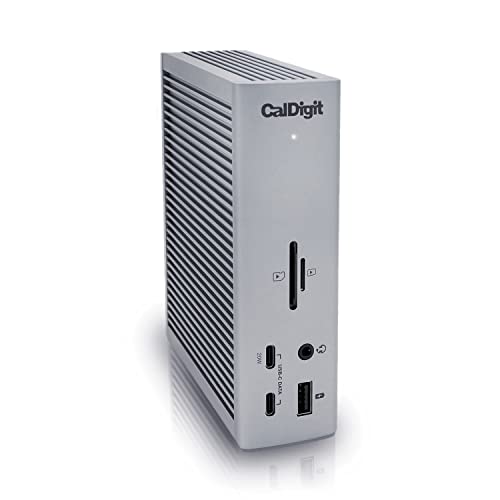
| CalDigit TS4 | Included 230W power supply | Up to 98W to the laptop |
| Plugable UD-3900PDZ | Included 135W power adapter | Up to 100W to the laptop |
A dock can charge the laptop without sending its full adapter rating
A docking station charges a laptop when its host connection supplies USB Power Delivery and the laptop accepts power through that port. Data, video and charging are separate capabilities: a dock may run a keyboard or display while the battery still needs the laptop's original charger. A USB-C shape by itself proves none of those functions.
The number printed on the dock's power brick is the capacity available to the whole dock, not an automatic promise to the computer. CalDigit pairs the TS4 with a 230W supply but publishes up to 98W for the host. The remaining capacity supports the dock's electronics and attached devices. CalDigit's TS4 specifications keep those figures separate.
Write down four different power facts
Start with the laptop's documented charging requirement or recommended adapter. Then find the dock's published output to the host—not a total, input or accessory-port number. Third, check the power supply included with the dock or the USB-C charger required for pass-through operation. Finally, confirm that the host cable supports the required power as well as the dock's data and video path.
The Anker 553 illustrates why the labels matter. Anker lists up to 100W Power Delivery input but only up to 85W to the laptop, and the 100W charger and USB-C-to-USB-C cable are separate requirements. Anker's A8380 page does not describe a 100W laptop output. By contrast, Plugable lists a 135W adapter and up to 100W host charging for the UD-3900PDZ. Plugable's current power table distinguishes both values.
Accessory charging belongs on another line. The TS4 can supply up to 20W from its front USB-C port and up to 15W from each downstream Thunderbolt port, but those figures do not replace its 98W host specification. Identify the physical host port in the manufacturer's diagram before connecting the laptop.
Need to compare actual models while you read?
See relevant dock optionsUSB Power Delivery negotiates an accepted level
A 100W dock does not force 100W into a computer. The source, laptop and cable negotiate a level that all of them support. A laptop designed to accept less can request less; a workstation that expects more may charge slowly, hold steady or lose battery under load even while the operating system reports external power.
USB-IF says the current USB Power Delivery specification can extend to 240W through supported USB-C equipment and a suitable full-featured cable. That is a standard ceiling, not a feature inherited by every dock. USB-IF's Power Delivery overview identifies the higher 140W, 180W and 240W ranges, while each dock and laptop still needs explicit support.
This is also why a replacement cable cannot be chosen by connector alone. Its supported power, data rate and video capability are separate. For the cable-specific decision, use the docking-station cable guide rather than assuming a charge-only USB-C cable can carry the dock's full feature set.
Choose a one-cable desk or keep the laptop charger
If one-cable operation is essential, reject any combination whose documented host output and charging protocol do not fit the exact laptop. The 85W Anker 553 can suit a lighter USB-C laptop when its separate power components are included in the plan. The TS4 offers 98W with its supply in the box. The Plugable UD-3900PDZ publishes 100W host charging and bundles its power adapter, while its display routes still have separate host and software requirements.
If a second power cable is acceptable, a dock can remain useful even when it cannot replace the original charger. That can be the safer plan for mobile workstations with proprietary or higher-power charging needs. Treat power as one row in the compatibility check alongside host connection, operating system and display support; the laptop compatibility guide covers those other paths.
Do not choose among 85W, 98W and 100W by the largest number alone. The right product is the one whose host connection, display behavior, included power equipment and published host output all match the desk. Open the three-model comparison to keep those limitations beside the charging figures.
Diagnose slow or missing charging before replacing the dock
First verify that the cable is in the dock's host port and that the dock is using its specified power supply or pass-through charger. Reconnect the known-good host cable supplied for that model, then test the laptop with its original charger. If the original charger also fails, the dock is not the only suspect. If it works, compare the dock's published host output with the laptop's requirement.
Next reduce the setup: disconnect power-hungry accessories, confirm that the operating system recognizes an external power source, and watch what happens during the workload that matters. A battery percentage that falls under a heavy workload does not prove the dock has stopped negotiating power; it may show that the accepted level is below current demand. Do not infer an exact charge rate from a wattage label or from battery percentage alone.
When displays or USB devices also fail, move to the broader dock troubleshooting guide. Charging-only symptoms should stay separate from video problems because a single USB-C connection can succeed on one path and fail on another.
Related questions
Will a 230W docking station send 230W to my laptop?
No. A figure such as 230W can describe the dock's power supply. The relevant laptop figure is the dock's published host output; the CalDigit TS4, for example, lists up to 98W to the host from its 230W supply.
Can a docking station work without charging the laptop?
Yes. Data, video and USB Power Delivery are separate capabilities. A compatible peripheral or display path can work even when the host port does not accept charging or the dock does not supply enough power.
Why does my laptop charge slowly through a dock?
Common explanations include a host output below the laptop's preferred level, a lower-rated pass-through charger or cable, an unsupported charging profile, or a workload consuming power faster than the negotiated input replenishes it. Compare documented figures before replacing hardware.
Sources & specifications
- Anker 553 8-in-1 A8380 specifications
- CalDigit TS4 specifications and power distribution
- Plugable UD-3900PDZ specifications and power table
- USB-IF USB Power Delivery overview
Research checked September 30, 2026. Product revisions, firmware and operating systems can change compatibility.